
Ginsberg Annual Report 2026 - Text Only
COVER:
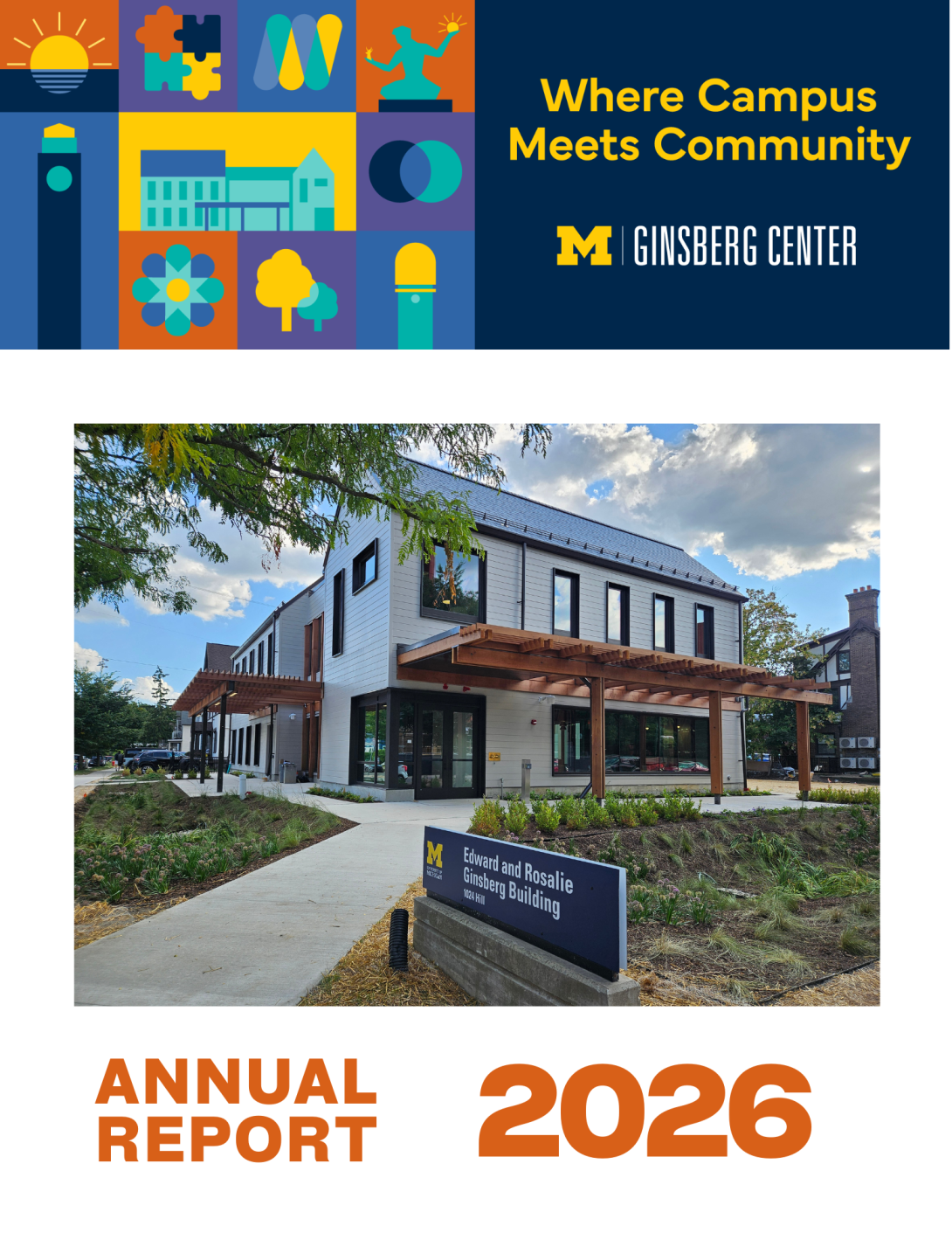
There is a graphic header at the top of the page. The blue background contains the phrase “Where Campus Meets Community” above a block M alongside the text “Ginsberg Center”. Below is one image in the center of the page. The image includes a photo of the new Edward and Rosalie Ginsberg Center building taken from the outside.
TABLE OF CONTENTS
1 Director’s Letter
3 Our New Home
6 Community Partnerships
8 Student Engagement
11 Academic Partnerships
13 Beyond Ginsberg
15 Staff & Advisory Boards
Image: Many students in front of a screen reading “The 2026 Student Grant Showcase”
Image: Students sitting in a large room with big windows, blue couches and small tables
PAGE 1
Image: Graphic of 4 interlocking puzzle pieces that are orange, navy, teal and yellow. Watermark in top right corner of page of enlarged version of same graphic.
Director’s Letter
This year marked an exciting milestone in our 30 year history, as we opened the doors to the Ginsberg Center’s new home, the Edward and Rosalie Ginsberg Building. Back on the corner of East University and Hill Street, the new building has been a labor of love from the architects (SmithGroup) to the builders (Demaria Construction) to the interior designers (Student Life’s design team), made possible by the generosity of the Ginsberg family, with support from Student life.
The welcoming, collaborative space designed to strengthen connections between University of Michigan and local communities not only meets all our programmatic and staff needs but is also visually stunning! The building has already received several awards for its design and it is the first net-zero ready building on campus. Everyone who has come through has remarked what an inviting space it is and we are eager to collaborate with folks on campus and in the community to bring it to life. We invite you to come see the new building for yourselves!
The new building energized our work as we explored all its possibilities while hosting numerous events this past year with our students, faculty & staff, and community partners. Our opening also prompted us to feature the new building in our updated branding: The Ginsberg Center is Where Campus Meets Community--reminding all of us that community engagement, at its heart, is place-based. We are all a part of, and contribute to, the neighborhoods we live in.
We have also been integrating community-engaged opportunities into numerous universitywide efforts to combat loneliness, promote civic learning, and make compensation practices more equitable. Our work within these spaces reflects the many ways that community engagement is central to the university’s mission to serve the public good. Our new space gives us a strong foundation, literally and figuratively, to expand access to community-engaged opportunities across campus, enriching the lives of students and our community partners for years to come.
In partnership,
Neeraja Aravamudan, Ph.D.
PAGE 2
Image: Small graphic of two overlapping trees: taller one in yellow, smaller one in orange on the right
A YEAR OF CONNECTION, LEARNING & PARTNERSHIP
6,282 Touchpoints
Image: Text box
434 Student Engagement Opportunities
Image: Three people
419 Requests for Center Support
Image: A handshake
298 Academic Supports Offered
Image: A graduation cap
466 Community Partners in our Network
Image: A web of individuals
3,000 Visitors to New Building
Image: A building
WHAT THIS WORK MAKES POSSIBLE
“The Ginsberg Center is a true gift to the community and non-profit sector. They have made it possible for many of us to learn things that benefit our organizations and help us to serve our community in a richer and more meaningful way.”
Local Community Partner
“Our Storytelling for Social Change (SFSC) intern was outstanding!! She listened to our wants and needs and was intentional about coming up with thought-provoking strategies to get the tasks completed. We were also impressed that she visited [our] center and did additional research to understand the importance of the assignment.”
SFSC Community Partner
“Participating in Ginsberg’s Community Technical Assistance Collaborative helped me think more critically about accessibility, equity, and impact when designing data-driven projects. Rather than seeing data analysis as something abstract...I began to understand it as a powerful tool for amplifying community voices and addressing real needs. For example, while working on a project that involved updating community resource data on a public website, I realized how even small technical decisions like how data is visualized or accessed can impact how useful that information is for community members. This experience encouraged me .”
CTAC Student
“I learned more about the ways Ginsberg Graduate Consultants are connected to larger institutional infrastructure which helped clarify our role in helping assess what resources we might offer to community partners as we develop a clearer understanding of their goals. I think it's important to register the difference between understanding oneself as an island versus understanding oneself as part of a network of relationships--the Ginsberg community really fostered that difference in disposition in me.”
Graduate Consultant
“Both of the staff I met with -- were extraordinarily knowledgeable about community organizations, resources at UM, and community-engaged pedagogy. They helped me to clarify my vision, map out practical next steps, and connect with a partner organization of my dreams.”
Faculty, LSA
PAGE 3
Image: Graphic of Side view of Ginsberg Building
Image: A photo of two individuals standing next to each other in front of a sign that reads “Edward Ginsberg Center”.
Caption: Bill & Inger Ginsberg
Photo Credit: Marc-Gregor Campredon
A New Home for the Ginsberg Center
From the moment the new Rosalie & Edward Ginsberg building opened, it has quickly become a vibrant hub for learning and collaboration, with over 3000 visitors passing through our doors since September. The energy and activity throughout the building has affirmed the importance of creating a dedicated space where students, faculty, staff, and community members can come together around shared goals.
Watching the building come to life has been one of the highlights of the year. Focus rooms became spaces for reflection and discussion, meeting rooms supported new university-community partnerships, and common areas fostered countless informal conversations and connections. We are deeply grateful to the Ginsberg family whose support made this vision possible. Their investment created more than a building, it has created a welcoming community space where collaboration can flourish and where the University's commitment to equitable community engagement is visible every day.
Learn more on our blog.
PAGE 4
Image: Small graphic of two overlapping trees: taller one in yellow, smaller one in orange on the right
Building Highlights
Combining Beauty, Function and Sustainability
Image: A photo of two individuals walking in the commons by the front desk.
Photo Credit: James Ewing
The Building’s inviting design has large windows, high ceilings and soothing blues and greens. It includes nods to the original building like using wood on the exposed ceilings like the original hardwood floors, and tile backsplashes that mirror the original fireplace finishes.
Every space is flexible with intentional choices that allow staff and visitors to adjust spaces to their needs and comforts, from sound and lighting to furniture that accommodates all bodies. Our updated technology allows for hybrid gatherings where everyone can participate, in person and online.
Image: two individuals in the student organization hub. One is sitting at a table watching the other write on the whiteboard.
Photo Credit: James Ewing
Image: Two individuals sitting in the America Reads library.
Photo Credit: James Ewing
Award-Winning Design
AIA Michigan
2026 Building Award
CAM: Construction Association of Michigan
2026 Project Achievement Award
Crew Detroit: Celebrating 40 Years
2026 Impact Award Nominee
NCSEA: National Council of Structural Engineers Associations
2026 Structural Engineering Excellence Nominee
PAGE 5
Image: Small graphic of symmetrical flower in teal, blue and yellow
Spotlight: Grand Opening
Ribbon Cutting
Image: A group of individuals standing in the Ginsberg Center commons behind a ribbon.
We officially opened the building in September 2025 with our Ribbon Cutting, inviting university leadership and special guests to honor and thank the Ginsberg family for their generosity. We were delighted to feature faculty and students who have been deeply impacted by their work. Read more about this event on our blog.
Setting the Stage
Image: Many individuals sitting and standing in the Ginsberg commons listening to a speaker at the front of the room.
We also hosted an Open House in late September where community and university partners shared what the Center has meant to them and what they hope for our collective future. Here, Jessica A.S Letaw, our Community-Leader-in Residence, shares how our histories are intertwined with a rapt audience.
Showcasing our Impact
Image: A group of individuals putting together a timeline of the Ginsberg Center.
The Open House gave us an opportunity to highlight our long history of incubating meaningful community- based programs for students, faculty and staff. We shared metrics and stories from over the years to highlight both the depth and breadth of our efforts. Learn about the Center’s History on our website.
Connecting Communities
Image: Community partners tabling in the outdoor area of the Ginsberg Center.
The Open House also allowed community partners to interact with guests, share their missions and recruit volunteers. We have found that post-COVID, our partners are eager to rebuild their volunteer pipelines and we are committed to supporting their efforts. Read more about our Open House on our blog.
PAGE 6
Image: Small graphic of two overlapping trees: taller one in yellow, smaller one in orange on the right
Community Partnerships
Connecting Community Priorities with University Resources
The Community Partnerships team collaborates with a diverse network of nonprofits, grassroots organizations, schools, government agencies, and other community-based organizations, each with unique priorities and goals for engaging with the University of Michigan. This year, our network included 466 community partners, with 32 partners connecting with us for the first time. 45% of partners are located in Washtenaw County, while 55% are based elsewhere in Southeast Michigan, reflecting both our deep local roots and our broader regional engagement.
This past year 53% of matches to community partners were directed to Ginsberg-led programs for U-M students, while the remaining 47% supported U-M courses, programs, student organizations, and research projects from across campus. These matches address a wide variety of issue areas and skills.
Horizontal bar chart showing the breakdown of matches by issue area: Education & Youth Development leads at 86, followed by Health & Wellbeing (46), Community, Civic, and Social Justice (35), Economic & Community Development (24), and Environment, Arts & Culture (10).
“We are incredibly grateful for this partnership. It was a tremendous asset and opportunity for growth this
summer. Thank you for providing us with this opportunity” Area Nonprofit Director
466 partners in our network
Image: Internet globe emoji
165 university-community matches
Image: Handshake emoji
82 unique community partners
Image: Two people emoji
PAGE 7
Image: Two overlapping circles, one in blue and one in teal.
Where We Connected Community Partners
Ginsberg connected community partners to opportunities both within our own programs and across the University of Michigan. Just over half (53%) of matches supported Ginsberg-led student engagement programs, while 47% connected partners to courses, research, student organizations, and initiatives across campus. While many matches support Ginsberg-led programs, the chart highlights the variety of connections made across campus, showcasing how Ginsberg helps community partners access university resources, expertise, and engagement opportunities beyond our own programs
Horizontal bar chart titled “Community Partner Connections Across U-M. Course leads at 29, followed by Project (15) and Event (15), Research (8), Program (5), and Other (4).
Community Priorities Addressed through Matches
Whether connecting partners with Ginsberg-led programs or resources across the university, each match represents an opportunity to support community priorities through collaboration. Across all community partner matches, Ginsberg supported work across a range of focus areas, reflecting the diverse goals and strengths of the communities we partner with. Education and youth development represented the largest area of focus, followed by health and wellbeing, community, civic and social justice, economic and community development, and environment, arts, and culture.
Horizontal bar chart showing community priorities assessed: Education & Youth Development leads at 86, followed by health and wellbeing (46), community, civic, and social justice (35), economic and community development (24), and environment, arts, and culture (10).
Beyond the priorities addressed through these partnerships, matches also reflected the diverse skills and expertise brought to community collaborations. Through these connections, community partners accessed support that strengthened their programs, expanded their capacity, and advanced their missions.
The most common areas of support included communications, marketing and design; education and tutoring; and assessment, data and evaluation, highlighting the range of ways U-M students, faculty, and staff contribute their knowledge and skills in response to community-identified needs.
Circle chart titled ‘Common Areas of Support’ listing Communications, Marketing & Design at 32%, Education & Tutoring at 25%, and Assessment, Data, & Evaluation at 13%.
PAGE 8
Image: Small graphic of four puzzle pieces connecting to make a square. They are orange, blue, teal, and yellow.
Student Engagement
Image: A group of students standing on the Ginsberg Center patio.
2,812 Unique Students
6,282 Unique Touchpoints
Students engaged with the Ginsberg Center through a wide range of learning and support opportunities this year. Through our outreach events, skill-building workshops, and individual advising appointments, we create multiple entry points for students to explore community engagement opportunities, strengthen community partnerships, and develop civic leadership skills. Together with our six Ginsberg programs and student organization grantmaking, these opportunities generated 6,282 student touchpoints, reflecting the many
ways students connect with Ginsberg throughout their time at U-M.
45 Outreach Events
78 Workshops
305 Advising Appointments
176 Students in 6 Ginsberg Programs
Image: Small graphic of symmetrical flower in teal, blue and yellow
Students at Every Academic Level Connect with Community Engagement
Pie chart illustrating student academic levels: 66% Undergraduate Students and 34% Graduate Students
These opportunities reached students from all 19 U-M schools and colleges, demonstrating the broad role community engagement plays across disciplines. Participants included both undergraduate and graduate students, with undergraduate students representing 66% of particpants and graduate students representing 34%, illustrating strong engagement across degree levels and academic pathways.
PAGE 9
Image: Small graphic of four lines connecting. Two blue lines and two yellow lines.
Spotlight: Celebrating Student Leadership & Community Partnerships
2026 Student Grant Showcase
Image: Many individuals sitting in three rows in front of a projector screen displaying ‘The 2026 Student Grant Showcase’.
Image: Students engaging with presenters at tables.
Image: Students engaging with presenters with posters.
More than 115 students, community partners, faculty, staff, and alumni gathered at the Ginsberg Center's Student Grant Showcase this spring to celebrate the impact of community-engaged learning and leadership. The event highlighted student projects supported through the Center’s Community-Engaged Grants, Alternative Break Grants, and the Community Leadership Fellows program, while also allowing community partners to share volunteer opportunities with an eager Crowd.
This year, we provided funding to 23 student organizations and supported 12 Community Leadership Fellows working alongside community partners from across Michigan on issues including housing and homelessness, public health, literacy, carceral justice, tribal legal services, refugee support, and youth development. Whether developing educational resources with local nonprofits, expanding access to legal services, or creating tools that amplify community voices, students demonstrated that meaningful engagement is built through sustained partnerships, shared learning, and a commitment to advancing community priorities. Read more highlights on our blog.
PAGE 10
Image: Small graphic of side view of the Ginsberg center.
Spotlight: Building Events
Book Talk
Image: Individuals listening to a speaker in the commons.
We invited Paul Fleming, Associate Professor of Public Health, to share highlights from his book
Imagine Doing Better: Why Policies Backfire and How Prevention Thinking Can Change Everything. Local community leaders joined the author to discuss connections between the book’s themes and their own social change efforts in Washtenaw County and across Michigan. Learn more on our blog.
Documentary Screening
Image: Individuals listening to a speaker in the commons.
We partnered with Breyko and the Ann Arbor Housing Commission to host a screening of the documentary A Letter to the West Side, bringing together community members and U-M stakeholders to explore the legacy of Ann Arbor's historic Black West Side. A post-film discussion with the director and community leaders focused on place, belonging, and the preserving community
stories. Learn more on our blog.
Hybrid Conference
Image: Many individuals sitting in the commons.
In late October, the Ginsberg Center hosted the 2025 Volunteer Management Hybrid Conference
held by Better Impact. The conference was designed specifically for those working in volunteer engagement. Learn more on our blog.
Advisory Board Mixer
Image: Many individuals smiling on a staircase.
The Ginsberg Center convened members of its Faculty, Student, and Community Advisory Boards
together for the first time to celebrate their contributions, build relationships, and inform our plans for the Center and community engagement more broadly. Learn more on our blog.
PAGE 11
Academic Partnerships
The Ginsberg Center partners with faculty and staff across all 19 U-M schools and colleges to strengthen community-engaged teaching, research, scholarship, and co-curricular learning through a range of supports.
783 TOUCHPOINTS WITH ACADEMIC PARTNERS
54 TOUCHPOINTS WITH COMMUNITY PARTNERS
481 UNIQUE ACADEMIC PARTNERS
Academic Partner Support by Type
Horizontal bar graph displaying number of consultations, partnerships, workshops, events, and grants provided, 2025–26. 138 Consultations Provided, 68 Matches Made, 51 Requested Workshops Delivered, 21 Faculty & Staff Workshops & Events, 20 Grants Provided
Community Engagement Grants Amplify Impact for Faculty, Community and Students
A Ginsberg Center Community Driven Engagement Grant supported a partnership between Dr. Angubeen Khan, Assistant Professor of Health and Human Services at UM-Dearborn, ACCESS Community Health and Research Center, and the Center for Arab Narratives to transform community-engaged research on intimate partner violence and reproductive health among Arab American women into an arts-based social media campaign. Drawing on input from nearly 100 women and community stakeholders, the team collaborated with a local artist and community ambassadors to illustrate the story of “Layla,” a fictional Dearborn survivor, while raising awareness of cultural barriers and highlighting resources available through ACCESS. Amplified by partners including Arab Women United and Dearborn Public Health, the campaign generated more than 4,000 Instagram views and 1,900 LinkedIn impressions. The project also advanced undergraduate learning through language translation, poster development, and conference presentations, demonstrating how research can foster community awareness, agency, healing, and change.
“The engagement on these posts is promising when we think about how community responds to research and how they can use findings to inspire agency and change in their own homes.”
Dr. Angubeen Khan, Ginsberg Grant Recipient
Image: Dr. Agubeen Khan
PAGE 12
Image: Small graphic of four lines connecting. Two blue lines and two yellow lines.
Spotlight: Recognizing Community Partner’s Contributions
The Ginsberg Center in collaboration with multiple community-engaged units on campus launched a Community Partner Compensation Event Series to reimagine how the university can better recognize community partners for their expertise and contributions. The series brings together community members, faculty, staff, and administrators to understand and improve community partner compensation practices at UM, and received funding support from U-M’s Democracy & Civic Empowerment Initiative.
Image: Individuals brainstorming with sticky notes in the commons.
The kick-off event in March centered around collaborative problem-solving. Using a Design Jam format to include as many perspectives as possible, participants worked together to reflect on current policies and practices to make suggestions for best practices moving forward. The question that centered participants’ work was, “How might we improve how community partners are compensated at U-M?” The goal was to collect as many ideas and solutions as possible to inform the agendas of working groups that evolved from the initial event.
At the conclusion of the event, working groups identified three potential strategies: the development of shared community-based values, a menu of current and potential options for recognizing partner contributions, and components of an online portal for university and community
partners to use, track, and complete payments. These working groups will present preliminary deliverables in September, to gather feedback for the final presentation to the broader university community later this fall.
Image: Individual with a microphone presenting ideas on a poster with many sticky notes in the commons.
By centering community voices and collaborating with other U-M units, we are building more transparent, equitable, and sustainable partnerships between communities and U-M, while putting our principles into practice. Learn more on our blog.
PAGE 13
Image: Small graphic of symmetrical flower in teal, blue and yellow
Beyond Ginsberg
Image: Front view of the Ginsberg Center
This year, we intentionally initiated and joined efforts to expand the reach of our mission into more areas across and beyond campus. These partnerships highlight the value of civic learning, the benefits of service for improving mental health, and the connection between community engagement and scholarship.
Image: Small graphic of symmetrical flower in teal, blue and yellow
Integrating Civic Learning
Ginsberg Center helped launch Civic Learning Week to highlight the many opportunities available within Student Life units year-round through projects and partnerships with peers, community organizations, local businesses, and public service programs. These opportunities help students tackle real-world challenges while developing skills to collaborate and lead within their communities, while at U-M and after.
Image: Small graphic of symmetrical flower in teal, blue and yellow
Combating Social Isolation
Learn more: https://record.umich.edu/articles/impact-institutes-awards-first-seed-funding-to-10-research-teams/
Ginsberg Center joined a cross-campus effort to combat social isolation and loneliness through the University of Michigan's Impact Institute for Social Prescribing. Ginsberg is leading the ServiceRx component, connecting students with local volunteer and community engagement opportunities that promote well-being as an alternative or complement to medical interventions.
Image: Small graphic of symmetrical flower in teal, blue and yellow
Supporting Scholars
Learn more https://ginsberg.umich.edu/mijournal
Center publishes the Michigan Journal of Community Service Learning (MJCSL), which is widely recognized as a leader in the field of community-engaged scholarship. Since 2014, we have worked to become more accessible to a wider audience through support for junior scholars and inviting submissions from beyond the social sciences. We devote one issue a year on a particular themes that broaden the scope of content and
readership and support strategic partnerships with scholars and universities across the country.
PAGE 14
Image: Small graphic of symmetrical flower in teal, blue and yellow
From Campus to Career: The Lasting Impact of Community Engagement
The skills students develop through the Ginsberg Center don't end at graduation—they become the foundation for meaningful careers and community leadership. Current students consistently report growth in the knowledge, skills, and mindsets needed for community-engaged work, while alumni identify many of these same competencies as essential in their professional lives years later.
Community Engagement Skills that Grow and Last
Student Growth Area: Understanding and empathizing with community members Translates to Alumni Value: Cultural humility and working across lines of difference
Student Growth Area: Understanding root causes of community issues Translates to Alumni Value: Understanding systems of power and inequity
Student Growth Area: Evaluating and reflecting on community work Translates to Alumni Value: Project management and organizational skills
Student Growth Area: Working with community organizations and community members
Translates to Alumni Value: Building partnerships and cross-sector collaboration
The Long-Term Impact of Community Engagement Experiences
This year, we surveyed alumni who participated in Ginsberg Center programs and graduated between 2015 and 2025 to better understand the long-term influence of their experiences. Their responses provide insight into career pathways, continued commitment to community engagement, and the enduring value of the skills developed through Ginsberg programs.
“I am grateful to the Ginsberg Center for helping me identify the value of my current work, which enables me to contribute to my community’s well-being (and my own) on multiple levels of scale. Ginsberg Alum
79% Developed skills relevant to career goals
69% Confirmed Career Interests
39% Reinforced Commitment to Community Engagement
To learn more about what we learned from our alumni, please view the full Alumni Report.
PAGE 15
Image: Headshots of Ginsberg Center’s full-time staff members.
Amanda Healy, Assistant Director for University-Community Partnerships
Brianna Christy, Data & Evaluation Specialist
Dave Waterhouse, Associate Director of the Ginsberg Center
Elizabeth Netcher, Civic Engagement Manager
Gabbi Wassilak, Student Outreach & Engagement Manager
Gaylin Moore, Academic Partnerships & Services Coordinator
Jesse Carr, Assistant Director for Student Learning & Leadership
Jessica Kane, Academic Partnerships Manager
Juliya Wicklund, America Reads Manager
Kate Livingston, Associate Director for Teaching, Research & Academic Partnerships
Kayla Grant, University Partnerships Manager
Maria Mora, Administrative Assistant
Nicole Springer, Editor, Michigan Journal of Community Service Learning
Neeraja Aravamudan, Director
Farewell and thanks to the staff who transitioned off the Ginsberg team this year: Hawa Haji-Hassan, Community Partnerships Manager
Graduate Student Staff
Adeli Block, Engaged Learning Graduate Consultant
Alaina Perez, Communications Graduate Assistant
Amanda Lawman, America Reads Graduate Assistant
Amy Michael, Engaged Learning Graduate Consultant
Apoorva Halasani, CTAC Student Consultant
Austin Geer, Graduate Program Assistant
Carlos Garlina, Engaged Learning Graduate Consultant
Cynthia Adebayo, Engaged Learning Graduate Consultant
Demet Kayasabi, Engaged Learning Graduate Consultant
Eda Bozkurt, Engaged Learning Graduate Consultant
Eleanor Garnett, CTAC Student Consultant
Eric Whitmer, Engaged Learning Graduate Consultant
Faridat Agboola, Engaged Learning Graduate Consultant
Fhrynée Lambert, Engaged Learning Graduate Consultant
Fenton Lawler, CTAC Student Consultant
Gabrielle Young, Graduate Program Assistant
Gina Hsu, Engaged Learning Graduate Consultant
Hana Chung, Engaged Learning Graduate Consultant
Haneen Alaouie, Graduate Marketing Coordinator
Hanikka Munn, Engaged Learning Graduate Consultant
Indhira Vadivel, CTAC Student Consultant
J’Mauri Jackson, Graduate Program Assistant
Ketura Abdullah, Engaged Learning Graduate Consultant
Laura Perez-Villagomez, CTAC Student Consultant
Leela Riesz, Engaged Learning Graduate Consultant
Medha Rao, CTAC Student Consultant
Melanie Martinez, CTAC Student Consultant
Noelle Kellogg, Community Partnership Graduate Consultant
Silvia Hernandez, Community Partnership Graduate Consultant
Stephanie Renteria, Engaged Learning Graduate Consultant
Symone Campbell, Community Partnership Graduate Consultant
Taylor Lewis, Engaged Learning Graduate Consultant
Viviana Velez, Engaged Learning Graduate Consultant
Undergraduate Student Staff
Adelaide Fackler, Building Engagement Coordinator
Caleb Jonas, Building Engagement Coordinator
Cielo Jimenez, Building Engagement Coordinator
Ciley Stokes, Digital Content Creator
Julia Hernandez, Undergraduate Program Assistant
Leah Ankutse, Building Engagement Coordinator
Sofia Golubic, Building Engagement Coordinator
Tahlia Davis, Building Engagement Coordinator
Tiffany Sudijono, Visual Marketing & Design Assistant
Student Advisory Board
Alimatou Sarr, Public Policy
Eda Bozkurt, Architecture & Urban Planning
Gia Verma, Literature, Science & the Arts
Hillary Poudeu Tchokothe, Literature, Science & the Arts
Kaylyn Wilson-Hill, Literature, Science & the Arts
Madeline Wren, Public Policy
Simar Bhatia, Literature, Science & the Arts
Tahlia Davis, Literature, Science & the Arts
Ty Anderson, Architecture & Urban Planning
Yuvika Mukherjee, Literature, Science & the Arts
Zena Aljilehawi, Literature, Science & the Arts
Community Advisory Board
Allison Lucas, Chief of Staff - CIV:LAB
Chris Brown, Supportive Services Director - Ypsilanti Meals on Wheels
Dan Comfort, Volunteer Coordinator - United Way of Southeastern Michigan
Gail Wolkoff, Executive Director - Educate Youth
Heidi Miller, Senior Director of Learning - Center for Success Network
Jessica Letaw, Co-Founder - FutureRoot
Jenna Mares, Director of Education, Outreach, and Welcoming - Ozone House
Laquan Hill, Deputy Director - A Brighter Way
Marissa Alaniz, Director of Development - Garrett's Space
Rev. Sue Pethoud, Community Liaison - Cass Community Social Services
Vanina Quinn, Volunteer Coordinator - Community Action Network (CAN)
Auxiliary Community Advisory Board Members:
Pastor Anna Taylor-McCants, Lead Pastor, ELCA Mission Developer, and Executive Director - FedUp Ministries
Brittnai Murillo, Development and Communications Manager - Apple Playschools
Derrick Jackson, Racial Equity Officer - Washtenaw County Racial Equity Office
Dayna Brimley, Community Health Analyst - Washtenaw County Health Department
Faculty Advisory Board
Maria Arquero De Alarcon, Taubman College of Architecture & Urban Planning
Ketra Armstrong, School of Kinesiology
Jenna Bednar, Ford School of Public Policy | LSA Political Science
Norm Bishara, Ross School of Business
Elizabeth Bondi-Kelly, College of Engineering
antonio c. cuyler, School of Music, Theater, & Dance
Paul Draus, College of Arts, Sciences, and Letters, UM-Dearborn | Detroit Center
Elisabeth Gerber, Ford School of Public Policy
Ayesha Ghazi-Edwin, School of Social Work
Laura Gultekin, School of Nursing
Alexis Handal, School of Public Health
Kate Hughey, Medical School | Michigan Medicine
Gabriela Marcu, School of Information
Kelly Maxwell, LSA Undergraduate Education
Mara Ostfeld, Ford School of Public Policy
Mike Shriberg, School for Environment and Sustainability | UM Water Center
Amy Thompson, College of Pharmacy
Dana A. Thompson, Michigan Law
Nick Tobier, Stamps School of Art & Design
Camille Wilson, Marshall Family School of Education
Amy Yorke, College of Health Sciences, UM-Flint
In addition to our advisory boards, the Ginsberg Center would like to thank the Ginsberg family, the Michaels family, Cacho-Nagrete Family and our other generous donors for their financial support. Finally, we continue to be grateful to all of our campus and community partners for sharing in this work.