
Written by Alaina Perez
On November 6th, the Ginsberg Center partnered with Breyko, a local production company led by CEO Kameron Donald, and the Ann Arbor Housing Commission to host a documentary screening of A Letter to the West Side. At the event, students, Ginsberg staff, U-M faculty, and community members gathered together to watch, talk, and learn about the rich history of Ann Arbor’s West Side. During intermission, guests came together for an interactive Q&A panel with three members of the Ann Arbor Community Leadership Council, Curtis Davis, Anyse Malcolm, and David Malcom.
A Letter to the West Side
This documentary-style film examines Ann Arbor’s West Side, which was once a vibrant center of the Black community with thriving Black-owned businesses and community spaces. Throughout the documentary, long-time residents described how the West Side was an ambitious and supportive environment for Black residents to build a foundation for growth and success. The film highlights the role that Black residents have played in the economic and civic development of the Ann Arbor we know today. Many residents went on to become trailblazers in their fields, achieving historic milestones, including becoming the first Black judge, teacher, and principal in the region. Through personal stories and historical accounts, A Letter to the West Side amplifies the experiences of a community whose neighborhoods have been dismantled through years of gentrification and U-M’s acquisition of property.
In interviews with former and current residents, A Letter to the West Side tells the story of Ann Arbor that many don’t know about, a city that’s changed its face many times over. The film turns the audience’s attention to that face and asks who feels like they belong in this community and why.
Place, History, and Lived Experience
Alimatou Sarr, a member of the Ginsberg Student Advisory Board, moderated the panel discussion held during intermission. Breyko invited members of the Community Leadership Council of Ann Arbor, Curtis Davis, Anyse Malcolm, and David Malcom to answer audience questions about their experiences living in Ann Arbor’s West Side. Sarr commented on how important it was to give attendees the opportunity to engage with the film and discuss their perspectives:
We had a great group conversation where participants connected their experiences of living and working in Detroit and Ann Arbor to the themes of the historic Black communities in the state featured in the documentary. It was great to see students, faculty, staff, and community members with various interests in attendance. I think this helped to give the conversation more depth and helped people connect to various aspects of the film and the story they were telling.
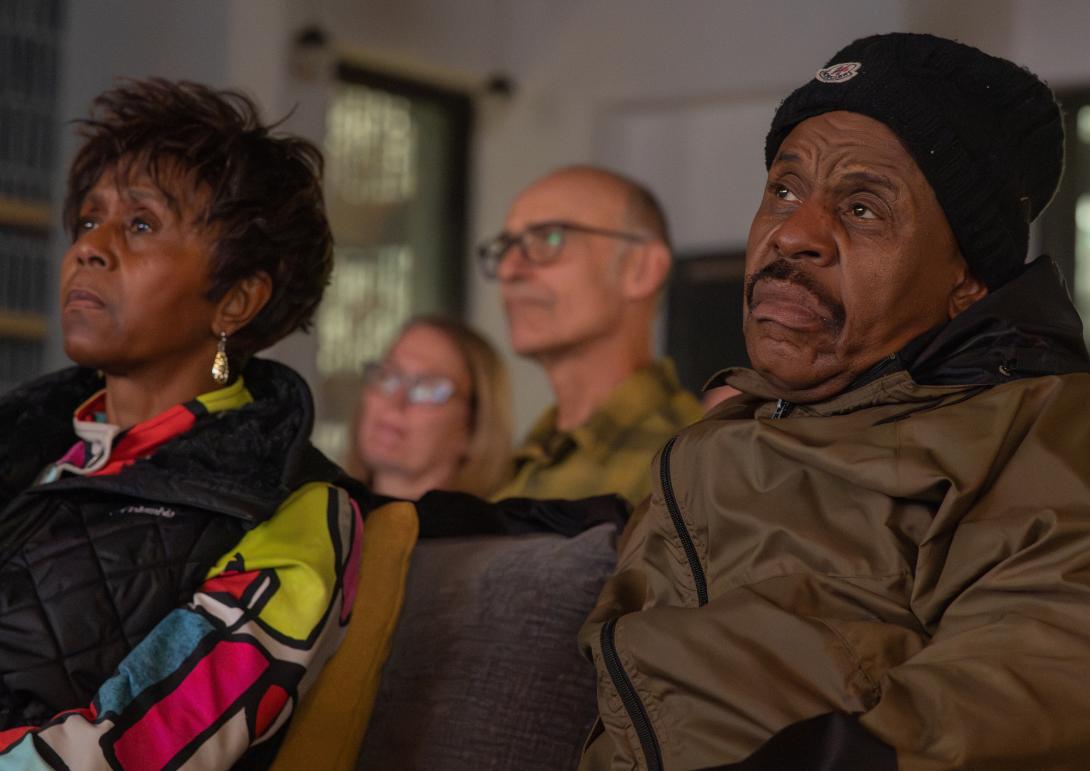
A diverse array of guests listened intently as the panel members conversed, making connections between the film and their own lives and perspectives.
We’d like to thank our panelists, as well as Kameron Donald and the rest of the Breyko team, for their commitment to Ann Arbor, its present and future.
Our Partnership with Breyko
Ginsberg Center has long had a relationship with Ann Arbor Housing Commission, but our partnership with Brekyo began shortly after the premier of A Letter to the West Side in February 2025. After the premier at Michigan Theater, Breyko sent out a form to attendees of the first documentary screening, welcoming feedback or interest in collaborating. Ginsberg reached out to express interest in hosting a future screening or collaborating with our Storytelling for Social Change (SFSC) program. In addition to this documentary screening, Brekyo has hosted an SFSC intern and ran a workshop on filmmaking for SFSC students. We look forward to seeing how our partnership with Breyko continues in the future, working together to build connections between campus and community.
How You Can Help
This movie night was hosted by the Ginsberg Student Advisory Board and co-sponsored by Ginsberg's Academic Partnerships and Community Teams.
The vision of fair and affordable housing in Ann Arbor relies on community support. Your support– whether through donations, partnerships, or amplifying our message– creates lasting change. Every contribution counts. Please consider donating today.
You can watch the full documentary on YouTube.