
Written by Alaina Perez
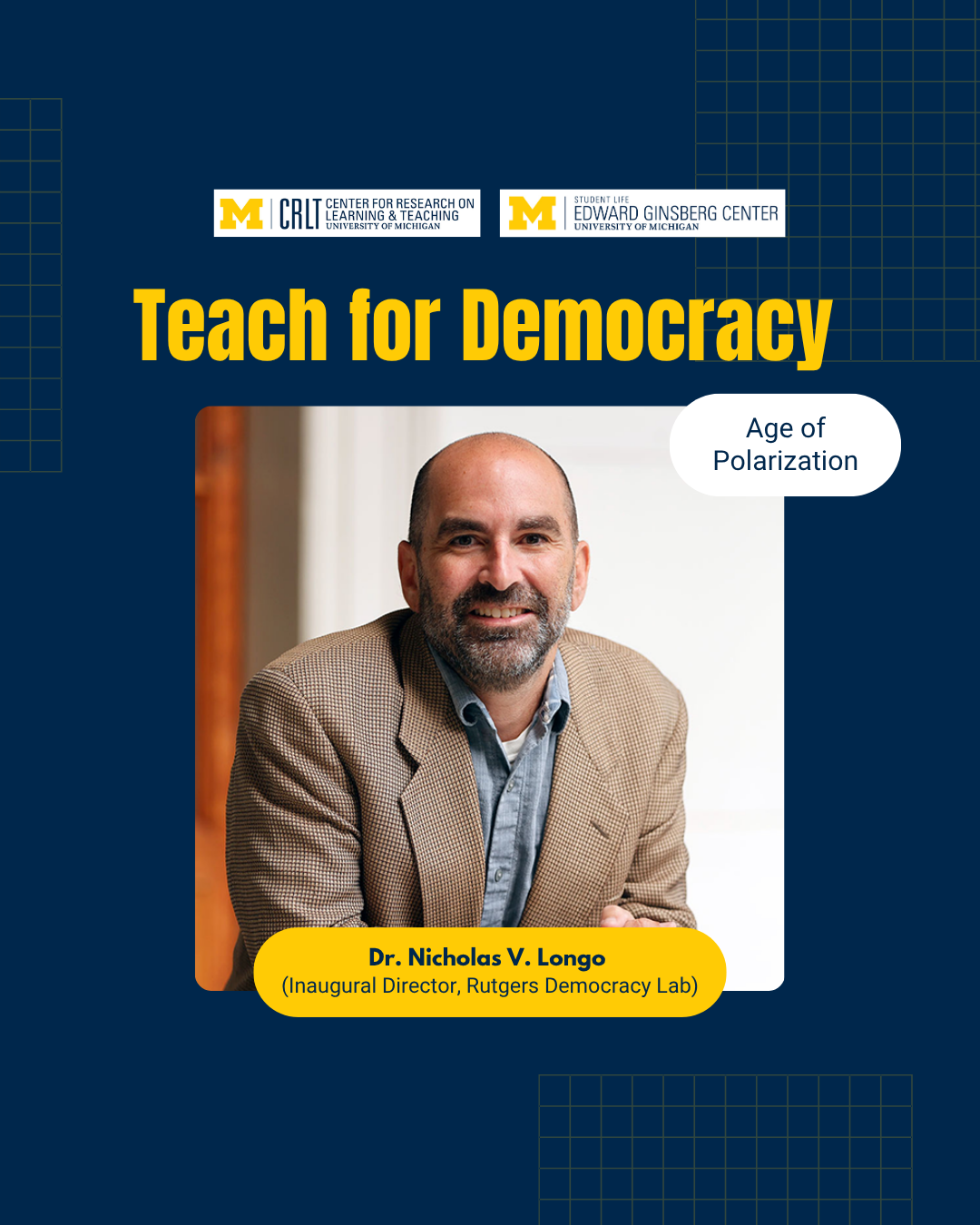
On September 14th, the Ginsberg Center partnered with the Center for Research on Teaching and Learning (CRLT) to host Dr. Nick Longo for his presentation, “Facilitating Constructive Dialogue in an Age of Polarization.” Longo, an author, professor, and Director of the Rutgers Democracy Lab, spoke about the pedagogical power at work in tense moments that may occur inside and outside of the classroom. Faculty, staff, and students attended the presentation to discuss and learn how to facilitate productive conversations with others. Longo emphasized that constructive dialogue is not meant to erase disagreement or avoid provocative subjects. Rather, it’s about providing “what we and our students need in order to engage those differences with curiosity, intellectual humility, care, and a willingness to stay in conversation.”
Constructive dialogue can be a helpful tool used for solving complex problems, asking us to develop civic skills by listening intently, asking questions, and finding common ground. At its foundation, it guides us toward bridge-building through practice and builds institutional readiness based on organizational missions and assets.
Dr. Longo discussed the “wicked problems” we face as a nation today: loss of trust, isolation, and polarization, and identified colleges and universities as sites for culture wars. Yet, the perception gap tells us that we’re far more similar across political party lines than we think.
The interactive presentation involved participants in discussing questions like, “What issues need to be discussed at U-M?” and “What strategic question would you ask to catalyze campus-wide dialogue?”
Building Bridges through Practice
In order for connections to be made and social change to happen, bridges must be built across the differences between us. Dr. Longo named the five principles of constructive dialogue that enable us to do that work:
- Let go of winning.
- Get curious.
- Share stories.
- Navigate conflict with purpose.
- Find what’s shared.
Reminding us that bridges don’t build themselves, Longo presented four conflict navigation tools that educators can use with students or others on campus when a tense moment arises: 1) Confront the Conflict, 2) Shift Gears (redirect students back to community agreements or class norms, 3) Name Values and Feelings, and 4) Ask Questions.
In creating and maintaining safe and brave spaces across U-M’s three campuses, we lay the foundation for constructive dialogue to take place.
We would like to thank Dr. Nick Longo for sharing his work with us and helping us converse joyfully and productively across our differences.