
Our 2025 Annual Report is available here (link)
Ginsberg Annual Report 2025 – Text Only
COVER:
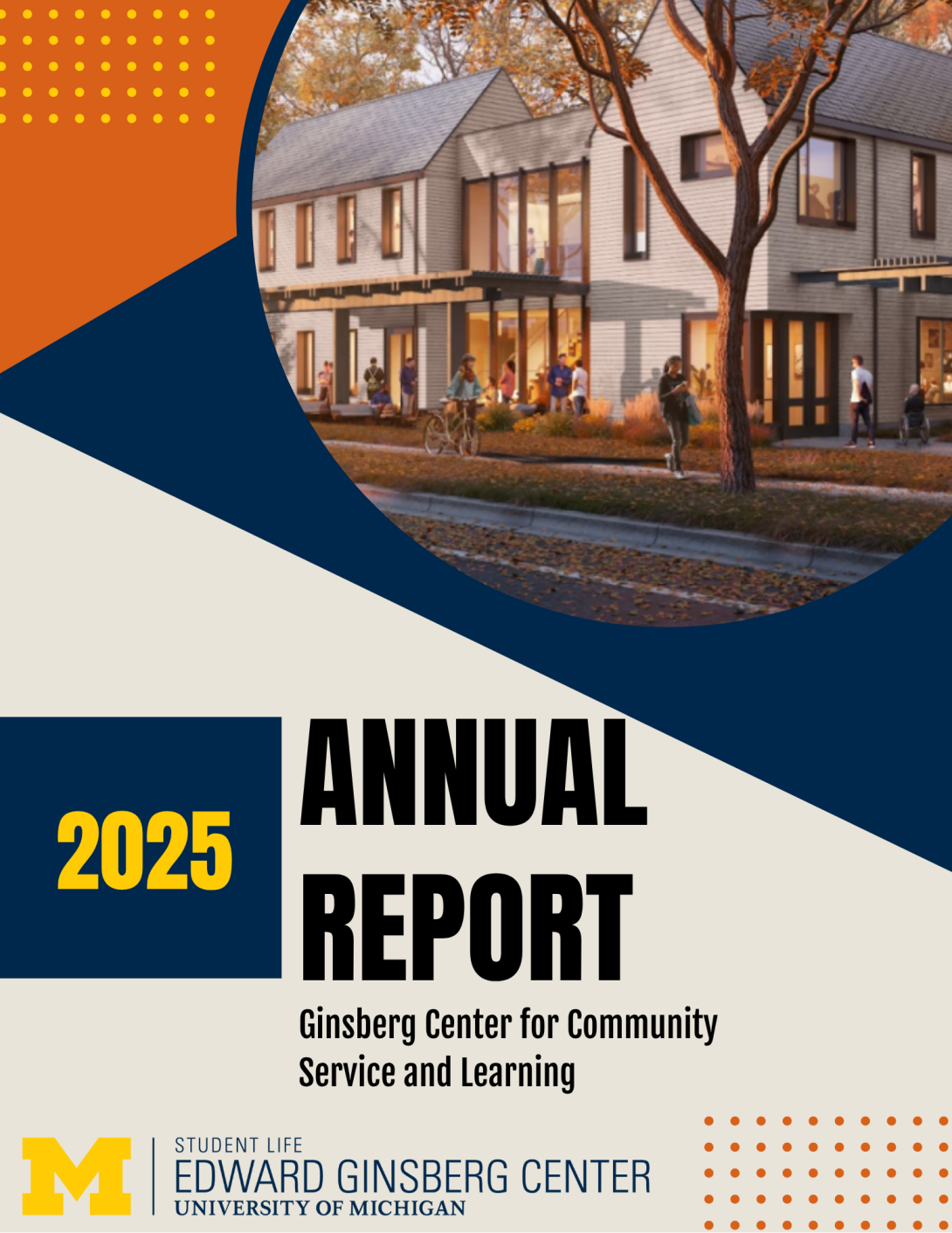
One semi-circular image appears in the top right corner of the page. The image includes a generated model of the new Edward and Rosalie Ginsberg Center building with students.
TABLE OF CONTENTS
1 Director’s Letter
2 Community Engagement
5 Student Engagement
7 Academic Partnerships
9 Ginsberg Center Staff & Advisory Boards
PAGE 1
Director’s Letter
This past year, we were thrilled to witness the deep engagement from U-M faculty, staff, students, and community partners participating in Ginsberg Center programs and services. Their dedication underscores the vital role of campus-community partnerships to our university's mission. As we navigate changes across every sector, it is more important than ever to reflect deeply on what drives us so we can work with others for the future we want.
In Spring 2025, we expanded the number of community-based internships for both undergraduate and graduate students with generous support from the University. Additionally, our work as a partner in the cross-campus UMICH Votes coalition helped to significantly boost voter turnout across the Ann Arbor, Flint and Dearborn campuses.
We joined forces with the Center for Research on Learning & Teaching to create and expand a promoting democracy workshop series, designed to prepare faculty and staff for current and future election seasons. Through collaborations with numerous community and campus partners, we successfully hosted a conference focused on building a solidarity economy. These efforts exemplify our commitment to living the principles that drive our work, and you can learn more about each of these efforts in this annual report.
As we look ahead to the Fall, we are elated to announce our move to the new Edward and Rosalie Ginsberg Building this August! This beautiful new space will allow us to be a physical campus hub for community engagement, and we invite our campus and community partners to create a vibrant space with us as we activate every corner, indoors and out. If you are in Ann Arbor, please stop by 1024 Hill Street--we’d love the opportunity to show you around!
In Partnership,
Neeraja Aravamudan, PhD
PAGE 2
Community Engagement by the Numbers
The Community Partnerships team collaborates with a wide range of nonprofits, grassroots organizations, schools, and government agencies, each with unique priorities, seeking to engage with the University of Michigan. We facilitate connections to both internal Ginsberg programs and external initiatives across the university.
Graph: 434 Community Partners in our Network
52% of our partners are in Washtenaw County & 38 new partners added just this year
Graph: 185 Matches between Community Partners and University Resources
52% of matches are unique community organizations
Graph: Ginsberg Program 93, Course 32, Campus Program 19, Campus Project 17, Research 13, Campus Event 8, Other 3
This past year 50% of matches to community partners were directed to Ginsberg-led programs for U-M students, while the remaining 50% supported U-M courses, programs, student organizations, and research projects from across campus.
These matches address a wide variety of issue areas and skills. Nearly 60% of matches support education-related initiatives. Youth Development (47%) and Health & Wellbeing (38%) also featured prominently. Our most common forms of engagement are Implementation & Product Creation (34%), Internships (32%), and Direct Service (24%), reflecting a strong focus on hands-on collaboration and real-world impact.
Graph: Education 58, Youth Development 47, Health & Wellbeing 38, Economic Opportunity 27, Justice 26, Equity 25, Environment & Food 16
Graph: Implementation & Product Creation 34, Internship 32, Direct Service 24, Research Support 12, Planning 10, Original Research 7, Coaching/Consulting 5
Note: Matches can be tagged in multiple ways, so percentages will not add up to 100%.
PAGE 3
Spotlight: Community-Based Internship Fund
Graph: 54 students
Graph: 53 projects
Graph: 42 sites
Meaningful Experiences
The Ginsberg Center was awarded a grant from U-M's Democracy, Civic Empowerment & Global Engagement Initiative to launch the Community-Based Internship Fund in January 2025. The Fund reduces barriers to equitable access, enabling students—regardless of financial circumstances—to pursue meaningful internships and ensuring broader participation in community-engaged learning.
The Fund supports student interns through August 2025, extending established internships and creating new opportunities for community-engaged work. Through these internships, students gain real-world experience, develop valuable skills, expand their professional networks, and contribute to projects that make a tangible impact in their communities.
Positive Outcomes
Students worked with community partners across Southeast Michigan spanning sectors like education, health, environment, arts, and social services. Evenly split between undergrad and graduate students, they contributed to a wide variety of community-based projects responsive to community-identified priorities. These included:
Designing and facilitating focus groups to help nonprofits gather resident input
Developing literacy curricula and tutoring materials for local schools
Creating multimedia content to help community organizations share their impact
Supporting youth programming and mental health promotion initiatives
Learn more on our blog!
Graph: $100,000 Awarded in Internship Funds
PAGE 4
Spotlight: Solidarity Economy Conference
On March 28, 2025, the Ginsberg Center partnered with Resource Generation Michigan to host Building Our Solidarity Economy—a daylong conference dedicated to skill- building, connection, and reimagining how we align our resources with our values to support community change.
Co-designed with student organizations such as Not Rich at UMich and University units such as the Community Action and Social Change (CASC) Minor, the conference centered student leadership, community partner expertise, and helped participants move from theory to practice.
Over 180 attendees—including students, faculty, staff, and community partners—participated throughout the day. The event featured interactive workshops, peer-to-peer learning, and opportunities to practice tangible civic and community engagement skills across a range of topics including:
Framing funding requests effectively
Navigating leadership styles and conflict resolution
Exploring pathways like social entrepreneurship, community organizing, and philanthropy
Image: Photo of the Solidarity Economy Conference attendees collaborating in tables.
“By participating in the conference, I gained a deeper understanding of the types of privilege that exist at UM, learned more about Washtenaw County as a broader community, and was prompted to envision a world where economies aren’t just about money. I met many new people who are passionate about social justice topics and are doing incredible work in our communities; It was an honor to learn from these leaders, and I will carry the knowledge I have gained into my future work in community change initiatives.” — Jordyn Coury, MSW student
The event exemplified the Ginsberg Center’s mission to build sustainable, equitable community partnerships and empower students as collaborators and changemakers. It also reinforced our commitment to the Pathways to Civic Engagement and Community Change framework, showing that real social transformation requires sustained, multifaceted participation. The Conference models how we foster deep, inclusive learning and community-rooted action.
PAGE 5
Student Engagement by the Numbers
Graph: 2,274 Unique Students
Graph: 288 Advising Sessions
Graph: 69 Outreach Events
Graph: 73 Workshops
This year, we had 5,371 touchpoints with students through our 6 Center programs, advising sessions, grants for student organizations, and various course-based and co-curricular workshops aimed at preparing students for community engagement.
Student Engagement Across Ginsberg Offerings
Graph: Advising 783 (Touchpoints) 283 (Unique Students), Outreach 506 (Touchpoints) 506 (Unique Students), Programs 1885 (Touchpoints) 201 (Programs), Workshops 2197 (Touchpoints) 1927 (Unique Students)
We engaged students from all 19 schools and colleges across the University of Michigan, highlighting the broad relevance and accessibility of our programs. As shown in the adjacent graph, over two-thirds of participants were undergraduate students, while nearly one-third were graduate students, reflecting strong engagement at multiple levels of academic experience. These numbers demonstrate that our offerings resonate with students across disciplines and degree levels.
Graph: Student Class Breakdown
32% Grad Students
68% Undergrad Students
PAGE 6
Spotlight: Supporting Student Voting
The Ginsberg Center partners with students, faculty, and staff to build knowledge, skills, and commitment to socially responsible civic engagement. This year, we focused on strengthening democratic engagement through non-partisan voter education, civics and media literacy, and dialogue across differences. Below, we highlight how our collective work continues to grow civic capacity and deepen impact at all levels.
Supporting Students Across the University
Turn Up Turnout (TUT) is a University of Michigan student organization sponsored by the Ginsberg Center, which provides staff advising and some financial support. TUT focuses on non-partisan voter registration, education and turnout on the University’s Ann Arbor, Flint, and Dearborn campuses. TUT is a critical channel for students encouraging and supporting civic and democratic engagement among their peers.
“This club is the perfect intersection of my interest in voting rights and politics. TUT is nonpartisan, so everything we do allows undergrad and graduate students to learn unbiased perspectives on local, state, and national issues. What I've learned from others in TUT and about myself is invaluable.” — Maurielle Courtois, Co-President of TUT-Ann Arbor
Image: A group of students participating in the Walk to the Polls event, holding a TUT banner.
During the Fall Semester, the Ginsberg Center provided support to a number of Turn Up Turnout (TUT) events and initiatives, including classroom presentations, registration/tabling, Walk to the Polls events, and Dinners for Democracy—a program series focused on nonpartisan voter education and key issues important to students. TUT members catalyzed engagement among students and community members across all three U-M campuses, while deepening their own civic learning and leadership skills.
In total, our Civic Engagement Manager had 407 individual touchpoints with 49 unique students involved with TUT, providing personalized support, mentorship, and coaching to strengthen their confidence and effectiveness as civic leaders.
PAGE 7
Academic Partnerships by the Numbers
The Ginsberg Center partners with faculty and staff across all 19 U-M schools and colleges to strengthen community-engaged teaching, research, and scholarship. Our academic partners include faculty at all ranks, deans, department chairs, university administrators, academic and co-curricular program staff, postdoctoral scholars, and other professionals whose work intersects with community engagement.
Graph: 525 Unique Academic Partners
Graph: 137 Consults Provided
Graph: 49 Grant Awarded
Graph: 25 Workshops for Faculty & Staff
Over the past year, we supported 525 unique academic partners with 885 touchpoints, with many participating in multiple offerings. Whether through one-on-one consultations, grant funding, interactive workshops, or direct connections to community partners, our goal is to provide the right resources and guidance to help faculty and staff integrate community engagement into their teaching, research, and programs effectively.
Academic Partner Engagement Across Ginsberg Offerings
Graph: Workshop Attendees 479, Consultation Attendees 198, Matched to Community Partners 91, Student Workshop Requesters 54, Grantees 50, Cohort Program Attendees 13
PAGE 8
Spotlight: Faculty & Staff Engagement
The Promoting Democracy Teaching Series is a collaborative partnership between the Ginsberg Center and Center for Research on Learning and Teaching (CRLT), that is offered during U.S. presidential and midterm election cycles. The series provides instructors with timely opportunities to reflect on the connections between election issues and their academic disciplines, learn strategies for promoting civic and democratic engagement through teaching, and better prepare for the impacts of election rhetoric on students and instructors alike.
Image: Photo of the faculty and staff attendees listening to the Promoting Democracy Teaching Series speaker.
Promoting Democracy Course Planning Retreat
36 faculty representing 12 schools/units and two U-M campuses gathered for the Promoting Democracy Course Planning Retreat. This event was co-sponsored by Ginsberg, CRLT, and the Office of the Vice Provost of Undergraduate Education, and was the start of the larger Series.
During the retreat, participants identified connections between their Fall courses and the issues raised by the November election, defined their learning goals for students, explored instructional resources, and prepared for potential challenges in the classroom. Through this event, our cohort built connections and a network of other faculty seeking to engage their students in democracy.
“This retreat helped me see the importance of teaching about the links between civic engagement, my discipline, health, and ultimately, the importance of encouraging my students to vote.” — Course Planning Retreat Faculty Participant
PAGE 9
Ginsberg Center Staff
Image: Composite photo featuring the headshots of the Ginsberg Center staff.
As of June 30, 2025
Amanda Healy, Assistant Director for University-Community Partnerships
Brianna Christy, Data & Evaluation Specialist
Dave Waterhouse, Associate Director of the Ginsberg Center
Elizabeth Netcher, Civic Engagement Manager
Gabbi Wassilak, Student Outreach & Engagement Manager
Gaylin Moore, Academic Partnerships & Services Coordinator
Hawa Haji-Hassan, Community Partnerships Manager
Jesse Carr, Assistant Director for Student Learning & Leadership
Jessica Kane, Academic Partnerships Manager
Juliya Wicklund, America Reads Manager
Kate Livingston, Associate Director for Teaching, Research & Academic Partnerships
Kayla Grant, University Partnerships Manager
Maria Mora, Administrative Assistant
Nicole Springer, Editor, Michigan Journal of Community Service Learning
Neeraja Aravamudan, Director
Farewell and thanks to these staff members who transitioned off the Ginsberg team this year:
Evelyn Metric, Communications Specialist
Riley Wilson, Student Engagement Coordinator
Theresa Krueggeler, University-Community Collaboratives Manager
PAGE 10
Advisory Boards
Community Advisory Boards
Jenna Mares, Ozone House
Dan Comfort, United Way of Southeast MIchigan
Vanina Quinn, Community Action Network
Allison Lucas, CIV:Lab
Marissa Alaniz, Garrett’s Space
Chris Brown, Ypsilanti Meals on Wheels
Heidi Miller, Center for Success Network
Dayna Brimley, Washtenaw County Health Department
Faculty Advisory Boards
Amy Thompson, College of Pharmacy
Amy Yorke, College of Health Sciences, UM-Flint
Antonio Cuyler, School of Music, Theater, & Dance
Bridgette Carr, Michigan Law School
Camille Wilson, Marshall Family School of Education
Ebbin Dotson, School of Public Health
Elisabeth Gerber, Ford School of Public Policy
Elizabeth Bondi-Kelly, College of Engineering, Electrical Engineering and Computer Science
Gabriela Marcu, School of Information
Gerald Davis, Ross School of Business
Jenna Bednar, Ford School of Public Policy | LSA Political Science
Jesse Austin-Breneman, College of Engineering, Mechanical Engineering
Katherine Hughey, Medical School | Michigan Medicine
Kelly Maxwell, LSA Undergraduate Education
Ketra Armstrong, School of Kinesiology
Lisa Kane Low, School of Nursing
Maria Arquero De Alarcon, Taubman College of Architecture & Urban Planning
Nick Tobier, Stamps Art School & Design; Ginsberg Faculty Leader in Residence
Teresa Satterfield, LSA Romance Languages & Literatures
Student Advisory Board
Ty Anderson, Architecture & Urban Planning - Urban Technology
Avery Berkebile, Literature, Science & the Arts- Economics & Philosophy
Simar Bhatia, Literature, Science & the Arts -Biology, Health, and Society & Biopsychology, Cognition, and Neuroscience
Eda Bozkurt, Architecture & Urban Planning-Architecture
Weronika Valvano, Public Health- Hospital and Molecular Epidemiology
Tahlia Davis, Literature, Science & the Arts-Sociology
Prashanti Donthireddy, Literature, Science & the Arts- Biology, Economics
Sarah Gallagher, Literature, Science & the Arts- Neuroscience
Raphael Onuku, Pharmacy- Medicinal Chemistry
Palak Srivastava, Literature, Science & the Arts -Philosophy, Politics, and Economics